Thigh Lift Surgery (Thighplasty)
Thigh lift surgery in Muzaffarnagar, also known as thighplasty, is a body-contouring procedure designed to remove excess skin and, when appropriate, excess fat from the thighs. The procedure can improve the contour and proportion of the upper legs, particularly when loose skin remains after significant weight loss, ageing or changes in body shape.
Depending on the location and amount of excess skin, different thigh lift techniques may be considered, including an inner or medial thigh lift, a vertical thigh lift or other customized approaches. The appropriate technique depends on your skin quality, anatomy, weight stability and aesthetic goals.
A consultation with Dr. Rohan Goel can help determine whether thigh lift surgery or another body-contouring procedure is appropriate for you.
Quick Facts
Surgery Time
2 to 3.5 hours (depending on complexity)
Anesthesia
General anesthesia
Stay Required
Outpatient (same-day discharge) or a 1-night hospital stay depending on the extent of tissue removal
Initial Recovery
10 to 14 days of initial downtime; return to desk work within 2 weeks
Final Results
The leg profile is instantly slimmer and tighter; deep surgical swelling settles over 3 months, and incision lines fade continuously over 12 months
Primary Indications: When is a Thigh Lift Needed?
A thigh lift specifically targets structural skin stretching and tissue laxity in the lower body. The most common indications include:
- Post-Weight Loss Skin Laxity (GLP-1 Medications like Mounjaro / Ozempic): Achieving massive weight loss through advanced metabolic treatments like Mounjaro or Ozempic is a major health milestone. However, rapid weight loss often leaves behind a severely deflated, loose skin envelope along the inner and outer thighs. Because skin lacks the elasticity to shrink back after significant volume loss, surgery is required to trim the redundancy.
- Severe Inner Thigh Chafing: Excess, hanging tissue along the inner thighs can rub together persistently during walking or exercise, leading to chronic skin irritation, painful rashes, and friction burns.
- Loss of Tissue Tone: Natural aging breaks down the body’s collagen and elastin framework, causing the skin over the quadriceps and inner thighs to sag downward, creating a crepey or loose appearance.
Tailoring the Technique to Your Anatomy
The pattern and length of the surgical incisions are carefully calibrated based on the location and amount of loose skin present.
- Crescent (Inner Thigh) Lift
- The Approach: The incision is hidden entirely within the groins’ natural crease, where the thigh meets the pubic area.
- Best For: Patients with mild-to-moderate loose skin restricted strictly to the upper third of the inner thigh.
- Vertical (Extended) Thigh Lift
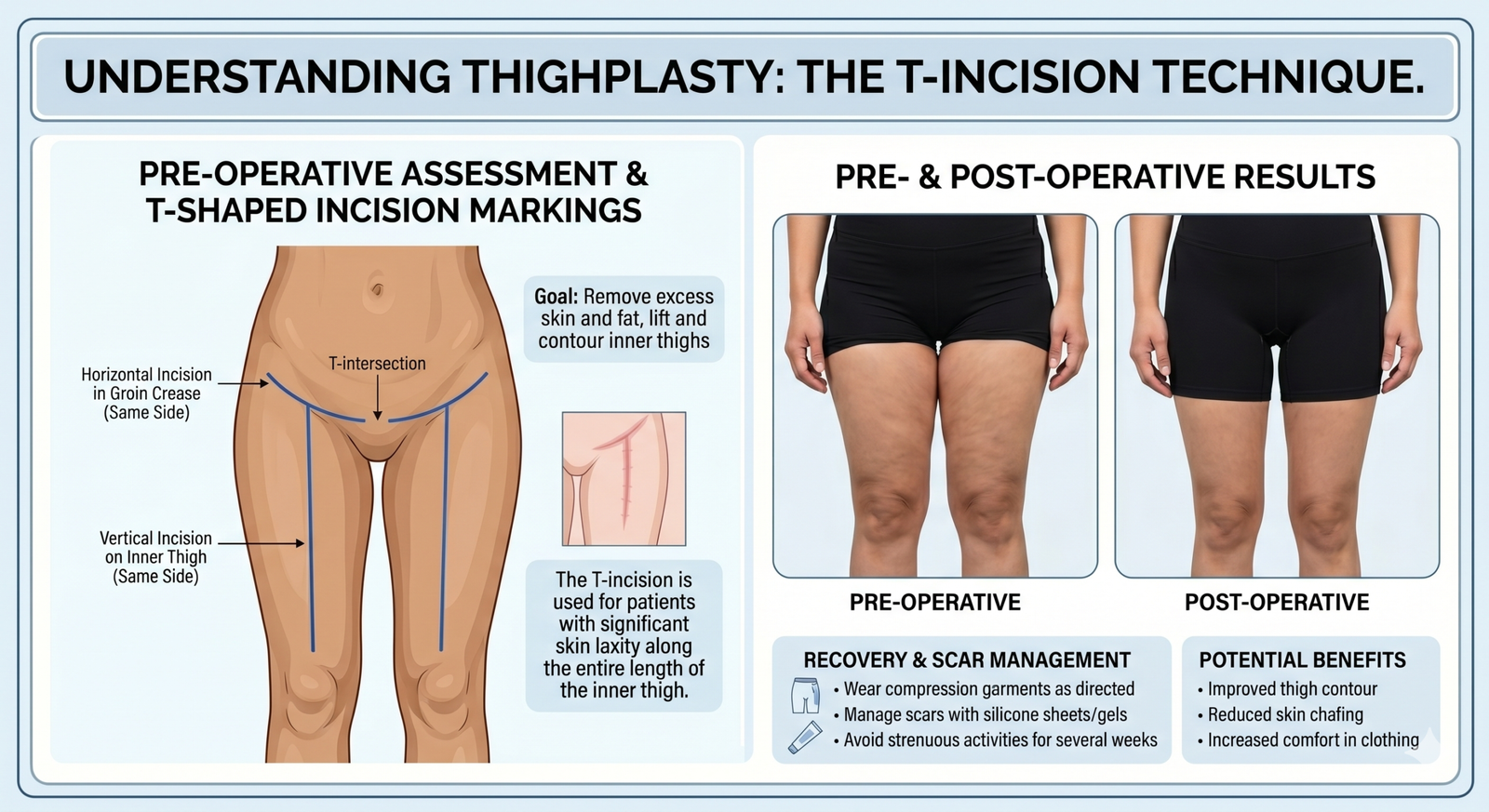
- The Approach: The incision begins at the groin crease and extends vertically down the inner aspect of the thigh toward the knee.
- Best For: Patients who have experienced massive weight loss and possess significant, hanging rolls of skin extending across the entire length of the thigh.
- Outer Thigh / Spiral Lift
- The Approach: Part of a lower body lift, the incision extends around the hip and lower back.
- Best For: Patients requiring structural tightening of the outer thighs, buttocks, and hips simultaneously.
Step-by-Step: How the Procedure is Performed
Step 1: Comfort & Safety
You are placed safely under general anesthesia, ensuring you remain completely asleep and entirely pain-free throughout the surgery.
Step 2: Liposuction Contouring
The surgeon frequently begins with high-definition liposuction to debulk dense fat layers along the inner knees or outer hips, establishing a smoothly tapered baseline.
Step 3: Tissue Reshaping
The pre-measured, redundant pattern of loose skin is precisely trimmed away. The surgeon places incisions carefully to ensure they are hidden as much as possible during normal posture.
Step 4: Deep Structural Anchoring
The underlying tissue network (fascia) is pulled taut and anchored firmly to the deep, supportive pelvic ligaments using heavy-duty internal dissolvable sutures. This prevents the scar from stretching or migrating downward later.
Step 5: Layered Closure
The skin edges are meticulously sealed using deep internal stitches and surgical skin glue. Soft, elastic compression garments are immediately placed over your legs.
The Recovery Timeline
- Sensation: Your thighs will feel tight, firm, and sore—resembling severe muscle soreness after an intense lower-body workout. Discomfort is safely managed with prescribed comfort medications.
- The Garment: You must wear your medical compression garment 24/7. It controls fluid retention, minimizes early swelling, and supports the newly tightened tissue planes.
- Mobility: Rest with your legs elevated on pillows, keeping a slight bend at the hips and knees to avoid putting direct tension on the groin incisions. Walking should be restricted to brief, necessary trips around the house.
- Increased Mobility: Early internal tightness begins to relax. Taking short, gentle walks at home is highly encouraged to promote healthy blood circulation and prevent deep vein thrombosis (DVT).
- Showering: Once approved by your surgeon, you can briefly remove the garment for a quick, lukewarm shower, ensuring you pat the surgical tapes dry before putting the garment back on.
- Work Return: Most patients feel completely comfortable returning to remote desk work or office schedules within 10 to 14 days, provided a prolonged commute or heavy bending can be avoided.
- The Contour Emerges: Initial surgical swelling drops off steadily, revealing a much slimmer, firmer leg profile.
- Exercise Progress: You can return to standard, low-impact cardiovascular workouts (like a stationary bike) around week 4, but you must avoid wide squats, heavy lower-body weightlifting, running, or high-impact sports until week 6 or 8, following explicit surgical clearance.
Side Effects vs. Warning Signs
|
Expected Normal Symptoms
|
Warning Signs (Call the Clinic Immediately)
|
|---|---|
|
Universal swelling, localized bruising, and inner thigh tightness
|
Sudden, dramatic swelling or severe hardening of just one leg
|
|
Mild swelling or fluid puffiness around the knees or ankles
|
Intense, burning localized pain or spreading redness over the skin
|
|
Temporary numbness or tingling in the thigh skin
|
Any separation or opening of the incision edges along the groin crease. A fever rising above 101°F (38.3°C)
|