Congenital & Pediatric Plastic Surgery
Congenital and pediatric plastic surgery is a highly specialized discipline dedicated to correcting structural differences, vascular anomalies, and developmental conditions present at birth or acquired during childhood. Operating on a growing child requires a deep understanding of developmental anatomy, skeletal growth patterns, and the long-term changes that tissue undergoes over time.
The primary objectives are to restore essential functions—such as normal speech development, comfortable feeding, and optimal joint mobility—while establishing natural facial and bodily harmony. Because these conditions affect a child’s early developmental milestones, treatment plans are carefully timed to align with structural growth phases and are delivered with an empathetic, family-centered approach.
Quick Facts
Surgery Time
Varies explicitly by condition. Structural repairs like cleft lip surgery are often performed within the first 3 to 6 months of life, while complex bone remodeling is coordinated with natural growth spurts.
Anesthesia
General anesthesia, meticulously monitored by a specialized pediatric anesthesiologist.
Stay Required
Outpatient for minor digit or ear corrections; 1 to 3 nights in the hospital for cleft palate or complex craniofacial remodeling to ensure smooth recovery.
Initial Recovery
1 to 2 weeks for primary skin and mucosal healing; long-term functional monitoring continues throughout childhood to support natural growth.
Common Congenital Conditions & Procedures
Pediatric reconstructive techniques address a wide spectrum of anomalies across the face, skull, hands, and body:
- Cleft Lip & Cleft Palate Restoration
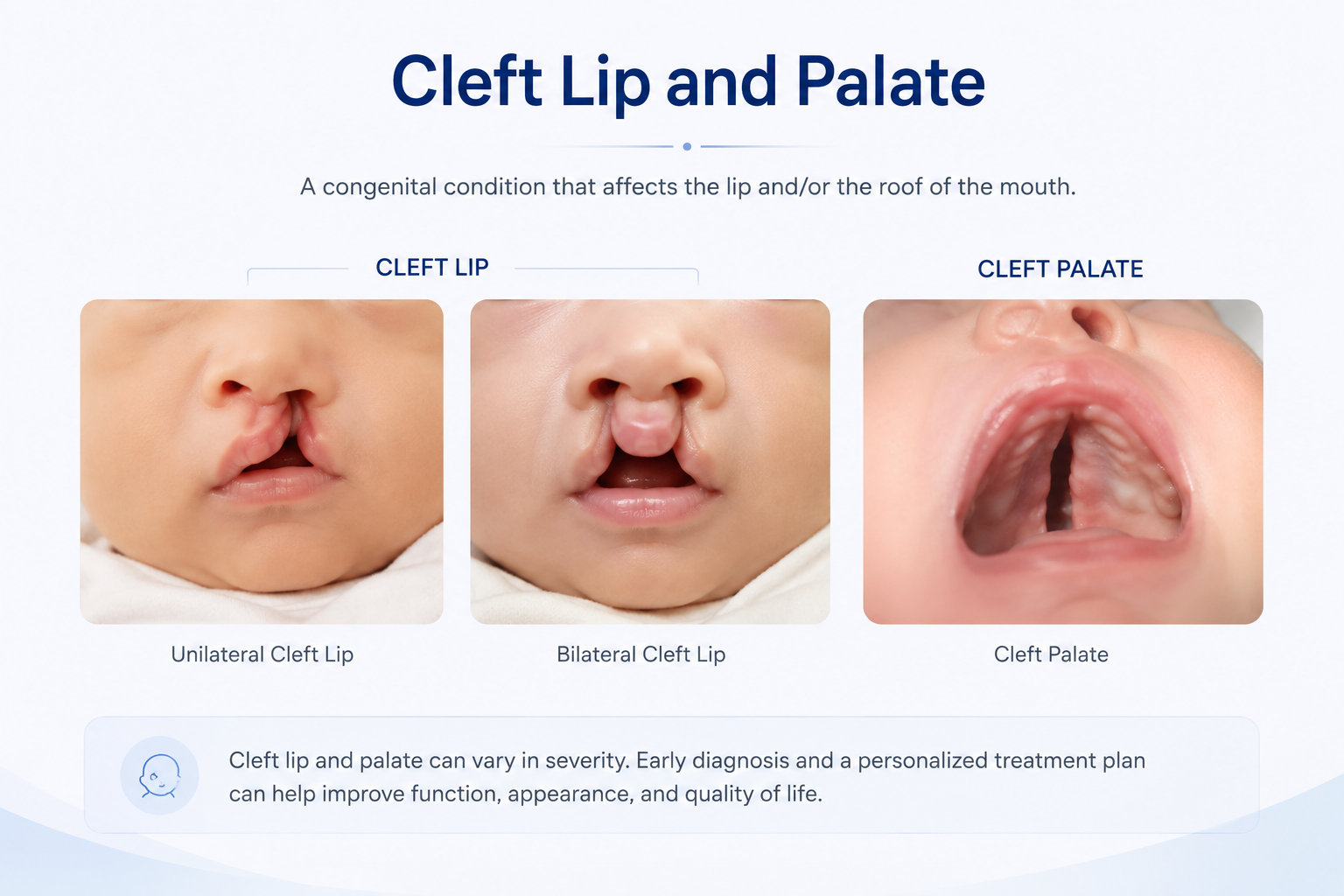
- Cleft Lip Repair (Cheiloplasty): Typically performed between 3 to 6 months of age. The surgeon realigns the separated muscle segments of the upper lip (orbicularis oris) and balances the nasal base, creating a functional muscular framework for normal feeding and future speech expression.
- Cleft Palate Repair (Palatoplasty): Usually timed between 9 to 18 months of age, before a child begins developing primary speech patterns. The tissue and muscles of the roof of the mouth are meticulously repositioned to seal the oral cavity from the nasal passage, preventing food regurgitation and enabling normal speech resonance.
- Pediatric Hand & Upper Extremity Differences
- Syndactyly Release (Webbed Fingers): Surgically separating webbed or fused digits, frequently performed around 1 to 2 years of age. Complex geometric incisions are used to design a natural, deep finger web space, sometimes incorporating full-thickness skin grafts to ensure unrestricted digital growth.
- Polydactyly Reconstruction (Extra Digits): Removing supernumerary fingers or thumbs. This goes beyond simple excision; it involves reconstructing the underlying joint capsule, realigning tendons, and preserving vital nerves to ensure the remaining digit is functionally strong and stable.
- Craniofacial & Ear Anomalies
- Craniosynostosis Repair: Addressing the premature fusion of one or more cranial sutures (the growth seams of a baby’s skull) which can restrict brain growth and cause an asymmetric head shape. Working alongside a pediatric neurosurgeon, the cranial bones are reshaped to create adequate volume for brain development.
- Microtia & Ear Reconstruction: Reconstructing a missing or underdeveloped outer ear, typically initiated around 6 to 9 years of age when the rib cartilage has grown sufficiently. The surgeon harvests a small amount of rib cartilage, sculpts it into a three-dimensional ear framework, and buries it beneath the scalp skin, followed by a secondary lift procedure.
- Otoplasty (Prominent Ear Correction): Reshaping prominent or protruding ears by folding and pinning the internal cartilage framework. This is safely performed after 5 years of age, once the ear cartilage has reached roughly 85–90% of its adult size and before the child enters primary school.
- Vascular Malformations & Congenital Nevi
- Hemangiomas & Vascular Anomalies: Treating overgrowths of blood vessels (such as strawberry hemangiomas or port-wine stains) using specialized medical management, targeted vascular lasers, or surgical excision if they obstruct vision, feeding, or airways.
- Giant Congenital Melanocytic Nevi: Serial surgical excision of large, dark congenital birthmarks over multiple stages, utilizing local tissue expansion to replace the nevus with healthy, adjacent skin.
The Multidisciplinary Care Framework
Children with complex congenital conditions are supported by a unified team of specialists to manage long-term development:
- Pediatric Plastic Surgeon: Coordinates and executes the structural, muscular, and aesthetic soft tissue reconstruction.
- Orthodontist & Pediatric Dentist: Manages jaw alignment, palatal expansion, and dental spacing, particularly in cleft care.
- Speech-Language Pathologist: Tracks and optimizes speech development, velopharyngeal function, and safe swallowing mechanisms following palate surgery.
- Audiologist & ENT Specialist: Monitors middle ear health and hearing pathways, as children with cleft palates are highly prone to fluid accumulation and middle ear infections.
Healing, Growth, & Post-Operative Milestones
- The Profile: Localized swelling, bruising, and minor fussiness are expected. For oral procedures, minor blood-tinged saliva is completely normal.
- Specialized Protection: Following cleft lip/palate or hand surgery, soft fabric arm restraints ("no-nos") are placed loosely around the child’s elbows to prevent them from accidentally scratching their lip or putting their fingers in their mouth.
- Diet: A specialized soft or liquid diet (using adaptive cups or syringes if directed) is maintained to protect delicate internal suture lines.
- Clinic Visit: Dissolvable sutures inside the mouth soften and wash away naturally. Fine external skin stitches are evaluated and removed if necessary by day 7 to 10.
- Activity Progress: Quiet, supervised play is encouraged. Rough contact, sharing toys that can be bitten, or high-impact outdoor playground activities must be avoided for 3 to 4 weeks.
- The Growth Factor: As your child grows, their reconstructed tissues will grow and stretch naturally alongside them.
- Secondary Refinement: Reconstructive teams track patients throughout childhood and adolescence. Minor secondary updates—such as speech-assisting procedures, bone grafting to the upper jaw, or soft tissue scar refinements—are planned at specific skeletal milestones to ensure optimal function into adulthood.
Side Effects vs. Warning Signs
|
Expected Normal Symptoms
|
Warning Signs (Call the Clinic Immediately)
|
|---|---|
|
Moderate swelling and pink bruising around the face or digits
|
Active, bright red bleeding from the mouth, nose, or surgical dressing
|
|
Minor, blood-tinged fluid tracking from the mouth or incision line
|
Inability to tolerate liquids, leading to signs of dehydration (dry diapers, no tears)
|
|
Temporary mild changes in feeding patterns or sleeping routine
|
Spreading dark redness, foul-smelling discharge, or extreme heat around the wound. A high fever rising above 101.5°F (38.6°C) that does not lower with pediatric acetaminophen
|
Frequently Asked Questions (FAQ's)
Trusted guidance to help you feel informed and confident about your surgical journey..
Surgical timing is precisely calculated based on safely maximizing your child's natural growth cycles. For instance, a cleft lip is repaired early (at 3 months) to help with feeding mechanics and seal the lip before facial muscles develop patterns around the cleft. Conversely, an ear reconstruction for microtia is delayed until age 6 to 9 because the rib cartilage must be large enough to safely harvest and use as a structural framework.
- For isolated conditions like extra digits or webbed fingers, a single procedure is often completely curative. For comprehensive conditions like a cleft lip and palate, treatment is typically a multi-stage journey. While the primary repairs are finished in infancy, secondary procedures—such as an alveolar bone graft around age 8 to 10 or a final rhinoplasty around age 16 to 18—are staged to match jaw and nasal bone growth spurts.
Children's skin possesses incredible regenerative capabilities, but their healing response can be very active. We use ultra-fine, hair-thin dissolvable stitches and place incisions carefully within the natural creases of the face, hands, or hairline. Once the skin closes completely, we initiate a gentle, pediatric-safe routine using medical silicone gels and sun protection to help the marks fade into faint lines.
For toddlers and young children, keeping routines simple and familiar is key. Bring their favorite comfort toy, blanket, or pacifier to the clinic. Use reassuring, age-appropriate language to explain that the doctor is going to fix a small part of their body to help them eat or play better. Our specialized pediatric team focuses on creating a calm, non-threatening environment for both the child and parents from the moment of check-in.