Gynecomastia Surgery (Male Breast Reduction)
Gynecomastia surgery is a highly effective procedure designed to reduce enlarged breast tissue in men, restoring a flatter, firmer, and more masculine chest contour. Enlarged male breasts can be caused by genetics, hormonal imbalances, weight fluctuations, or certain medications, and the condition often persists despite intensive diet and exercise.
By combining advanced liposuction with precise surgical excision, this procedure permanently removes excess glandular tissue and fat, providing a major boost to self-confidence and body image.
By removing excess, hanging skin and targeted fat deposits, an arm lift tightens the structural tissue framework from the underarm area to the elbow, restoring a toned, sculpted, and youthfully proportioned arm profile.
Quick Facts
Surgery Time
1 to 2 hours
Anesthesia
Local anesthesia with sedation, or general anesthesia
Stay Required
Outpatient (same-day discharge)
Initial Recovery
3 to 5 days for initial downtime; return to desk jobs within a week
Final Results
Chest flatness is visible immediately; final structural definition and skin contraction stabilize over 3 to 6 months
Understanding the Causes: Glandular vs. Fat Tissue
An effective treatment plan depends entirely on addressing the two types of tissue that can cause fullness in the male chest:
- True Gynecomastia (Glandular Tissue): This involves dense, firm, rubbery breast gland tissue directly beneath the nipple-areola complex. It is driven by hormonal shifts and cannot be burned off through diet or weight loss. It must be surgically excised.
- Pseudogynecomastia (Adipose Tissue): This is an accumulation of soft fatty tissue spread across the entire chest wall, often associated with weight gain. It can be easily treated using body-sculpting liposuction.
- Mixed Gynecomastia: The most common scenario, where a patient has a dense glandular core surrounded by a layer of soft chest fat. A combination approach yields the most natural, athletic results.
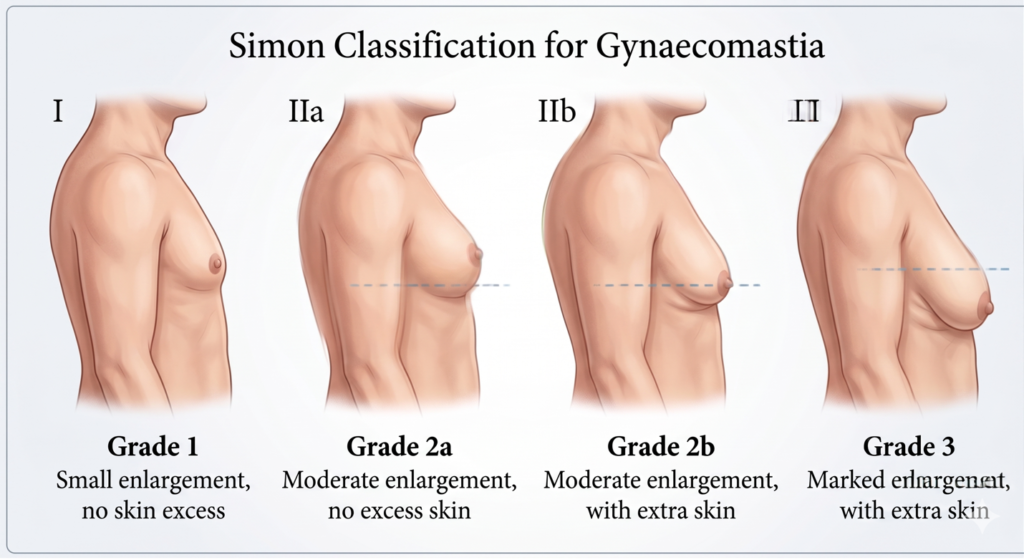
Grade | What it Looks Like | Best Treatment Options |
|---|---|---|
Grade 1 | Small swelling around the nipple, no loose skin. | Liposuction & Gland Removal: A tiny incision is made to remove the firm gland tissue and smooth out the area. |
Grade 2a | Moderate swelling, no loose skin. | Liposuction & Gland Removal: Liposuction shapes the chest, and the firm gland is removed. The skin naturally snaps back into place. |
Grade 2b | Moderate swelling with mildly loose or sagging skin. | Liposuction, Gland Removal + Skin Tightening: Gland and fat are removed. Advanced body-contouring tools or a minor skin trim help firm up the chest. |
Grade 3 | Significant enlargement with severe sagging (nipple sits below the crease). | Gland Removal + Skin Reduction: To achieve a flat, masculine chest, the excess tissue is removed, and the remaining skin is reshaped and tightened. |
Tailoring the Technique to Your Anatomy
The pattern and length of the incision depend heavily on the location and amount of loose skin present.
- Minimal Incision / Mini-Brachioplasty
- The Approach: A crescent or diamond-shaped incision is placed completely inside the natural fold of the armpit (axilla), leaving no visible scar on the arm itself.
- Best For: Patients with mild, loose skin restricted entirely to the upper third of the arm near the underarm.
- Standard (Full) Brachioplasty
- The Approach: An incision extending from the armpit down along the inside or the back of the upper arm, stopping just above the elbow.
- Best For: Patients with a significant, hanging “apron” of loose skin extending across the entire length of the upper arm (classic after major weight loss).
Step-by-Step: How the Procedure is Performed
Step 1: Comfort & Anesthesia
You receive deep sedation or general anesthesia, ensuring you remain completely relaxed and pain-free throughout the procedure.
Step 2: High-Definition Liposuction
A tiny, hidden 3 mm puncture is made near the fold of the armpit. A specialized, ultra-thin cannula is inserted to break up and vacuum out excess fatty tissue from the periphery of the chest, tapering the edges seamlessly into the abdomen and shoulders.
Step 3: Direct Glandular Excision
To remove the dense glandular core, a small, semi-circular incision is made right along the lower border of the areola (where the dark skin meets the lighter chest skin). The surgeon meticulously dissects and removes the firm gland tissue.
Step 4: Ensuring Areola Support
he surgeon leaves a thin, precise cushion of tissue directly underneath the nipple. This is a critical step that prevents the nipple from sinking inward or creating a "crater" appearance post-surgery.
Step 5: Seamless Closure
The incisions are closed using fine, dissolvable internal sutures and skin glue. A supportive, medical-grade compression vest is placed over your chest.
The Recovery Timeline
- Sensation: Your chest will feel firm, tight, and sore—very similar to the intense muscle burn felt after a grueling chest workout. Discomfort is mild-to-moderate and easily managed with prescribed comfort medication.
- The Compression Vest: You must wear your medical vest 24/7. It exerts uniform pressure across the chest wall to minimize fluid accumulation, control swelling, and support the skin as it adheres to the new, flat chest wall.
- Arm Movement: You can use your hands for eating and typing, but avoid lifting your elbows above your shoulders or lifting anything heavier than 5 lbs.
- Swelling Peak: Swelling and minor bruising around the lower chest or armpits peak around day 3 or 4 and then begin to drain away steadily.
- Work Return: Most patients feel completely comfortable returning to office desk work, administrative duties, or remote working by day 5 to 7.
- Showering: You can briefly remove the vest for a quick, gentle shower once approved by your surgeon, carefully patting the surgical tapes dry before putting the vest back on.
- Softening Scars: The faint pink incision lines along the bottom of the areola will begin to soften. You may feel temporary localized firmness under the nipple (healing tissue), which resolves over a few weeks.
- Activity Progress: Light walking is encouraged from day one. You can resume light cardio (like riding a stationary bike) at week 3, but you must avoid heavy bench presses, chest flys, running, or high-impact sports until week 6.
- The Vest Milestone: After week 3 or 4, you can typically stop wearing the compression vest during the day, though you may be instructed to wear it at night for a little longer.
Side Effects vs. Warning Signs
|
Expected Normal Symptoms
|
Warning Signs (Call the Clinic Immediately)
|
|---|---|
|
Sensation of tightness, stretching, or soreness across the pectorals
|
Sudden, dramatic swelling or severe hardening of just one side of the chest
|
|
Asymmetric swelling (one side settling faster than the other)
|
Intense, burning localized pain or spreading redness over the skin
|
|
Temporary numbness or altered sensation in the nipples
|
Fresh, active blood tracking continuously out of the punctures. A fever rising above 101°F (38.3°C)
|