Tummy Tuck Surgery (Abdominoplasty)

Abdominoplasty, commonly known as a tummy tuck, is a body-contouring surgical procedure that removes excess abdominal skin and fat and may tighten weakened or separated abdominal muscles when clinically appropriate. At RG Plastic Surgery in Muzaffarnagar, Dr. Rohan Goel evaluates each patient individually to determine whether a full or mini abdominoplasty is suitable based on their anatomy, goals and medical history.
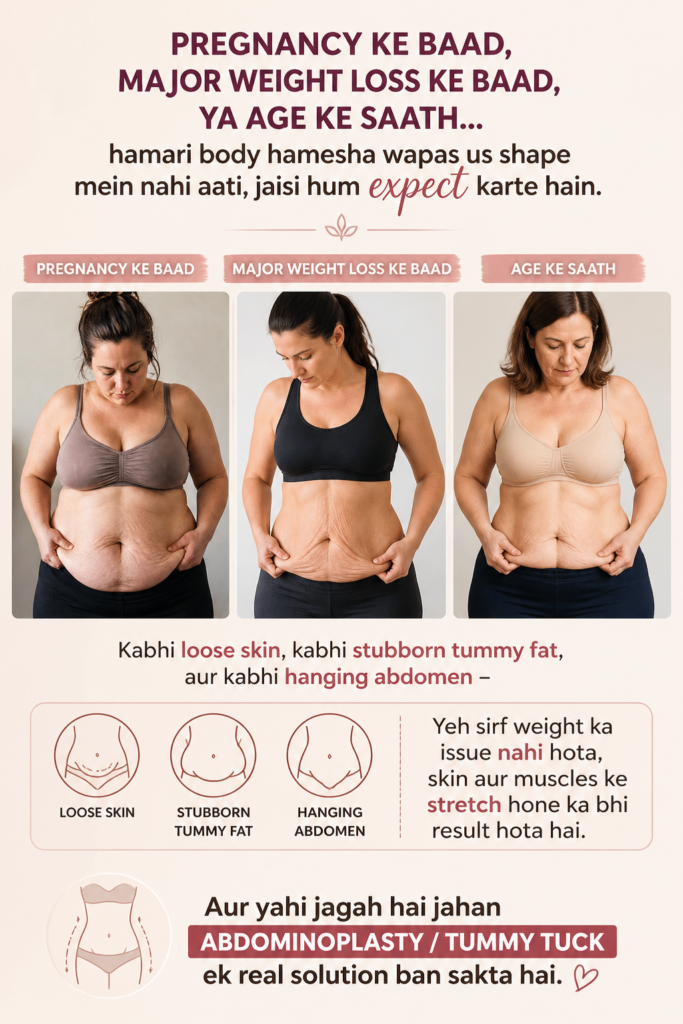
A tummy tuck may be considered after pregnancy, significant weight loss or changes associated with aging when loose abdominal skin and abdominal contour do not improve sufficiently with diet and exercise. During a consultation, your surgeon will discuss the expected benefits, limitations, risks, recovery and alternatives.
Quick Facts
Surgery Time
2.5 to 4 hours (depending on complexity)
Anesthesia
General Anesthesia
Stay Required
Outpatient (same-day discharge) or a 1-night hospital stay depending on the extent of tissue removal
Initial Recovery
10 to 14 days of initial downtime; return to desk work within 2 weeks
Final Results
The abdominal profile is visibly flatter immediately; swelling settles continuously over 3 months, and the low-profile incision line fades over 12 months
The Two Structural Pillars: Muscle Repair & Skin Tightening
An effective tummy tuck corrects structural changes across multiple tissue layers, focusing heavily on rebuilding the core from the inside out.
- Internal Muscle Repair (Correcting Diastasis Recti)
The Problem: During pregnancy or major weight gain, the left and right abdominal muscles (rectus abdominis) stretch apart, tearing the central connective tissue wall. This leaves the core permanently weakened, causing a persistent “pooch” or protrusion that cannot be resolved with traditional core exercises.
The Correction: The surgeon exposes the separated rectus muscles and pulls them back together in the midline, securing them with permanent, heavy-duty internal sutures.
The Structural Result: This creates an internal corset, narrowing the waist, restoring spinal support, and flattening the abdominal wall from the inside.
- Deep Skin Tightening (Excising the Cutaneous Envelope)
The Problem: Once skin is stretched past its natural elastic limit, it hangs loosely, creating a redundant apron of tissue in the lower abdomen, often accompanied by stretch marks.
The Correction: The loose abdominal skin is pulled downward like a tight window shade. The excess, redundant tissue is precisely measured and trimmed away permanently.
The Structural Result: Eliminates hanging skin folds, smooths out the surface texture, and tightens the lower abdomen.
Tailoring the Technique: Types of Tummy Tucks
-
- Full Abdominoplasty (Standard Tummy Tuck)
The Approach: A horizontal incision is placed discreetly below the bikini line from hip to hip, and a second tiny incision is made around the belly button.
The Action: Addresses the entire abdominal wall, from the pubic area up to the ribcage. The upper and lower abdominal muscles are completely tightened, excess skin is removed, and the belly button is neatly repositioned.
Best For: Patients with generalized loose skin and muscle separation above and below the navel.
- Mini-Abdominoplasty (Partial Tummy Tuck)
The Approach: A significantly shorter horizontal incision, similar to a C-section scar. The belly button is left completely undisturbed.
The Action: Focuses exclusively on the lower abdomen beneath the belly button. It tightens mild muscle laxity and removes a small apron of skin restricted entirely to the lower abdomen.
Best For: Patients with good upper abdominal tone who only have a localized “pouch” or loose skin below the navel.
- Full Abdominoplasty (Standard Tummy Tuck)
Step-by-Step: How the Procedure is Performed
Step 1: Comfort & Safety
You are placed safely under general anesthesia, ensuring you remain completely asleep and entirely pain-free throughout the surgery.
Step 2: Precision Incisions
The horizontal incision is mapped out low on the abdomen, ensuring the eventual scar can be easily hidden inside standard underwear or swimwear.
Step 3: Rebuilding the Core
The surgeon tightens and plicates the separated abdominal muscles with internal suturing to drop the profile flat.
Step 4: Liposuction Flank Sculpting
High-definition liposuction is often used simultaneously along the love handles (flanks) and upper abdomen to sculpt a smooth, contoured transition into the waistline.
Step 5: Redraping & Closure
The excess tissue is precisely trimmed away, the belly button is brought through a tiny new opening, and the incision is sealed with meticulous, layered dissolvable stitches. Surgical drains may be placed temporarily to prevent fluid accumulation.
The Recovery Timeline
- The Posture: Because the abdominal muscles and skin have been tightened significantly, you will walk with a slight forward hunch for the first 5 to 7 days. This is completely intentional and essential to protect the healing incision line from tension.
- Sensation: Your core will feel very tight, firm, and sore, resembling severe muscle soreness after an extreme workout. This is safely managed with prescribed comfort medications.
- Compression Garment: You will wear a supportive post-surgical binder or compression garment 24/7 to control fluid retention and support your core.
- Drain Management: If temporary surgical drains were placed, they are comfortably removed at the clinic once fluid output drops below a safe threshold (typically around day 2 to 3).
- You will gradually find it easier to stand upright as the tissue relaxes. Gentle, light walking around the house is highly encouraged from day one to promote healthy circulation.
- Work Return: Most patients return to desk work, remote duties, or office schedules by day 10 to 14, as long as heavy lifting or strenuous stretching is avoided.
- Softening Profile: Initial swelling begins to drop off steadily, revealing a beautifully flat, contoured stomach.
- Exercise Progress: You can comfortably return to standard cardiovascular gym workouts around week 3 or 4, but you must avoid direct abdominal exercises, heavy weightlifting, or high-impact sports until week 6 or 8, following your surgeon's explicit approval.
Side Effects vs. Warning Signs
|
Expected Normal Symptoms
|
Warning Signs (Call the Clinic Immediately)
|
|---|---|
|
Walking with a slight forward bend for the first week
|
Sudden, asymmetric swelling or hard, painful fluid bulges on one side
|
|
Universal swelling, localized bruising, and core tightness
|
Intense, burning localized pain or spreading redness over the skin
|
|
Temporary numbness in the lower abdominal skin
|
Shortness of breath, sharp chest pain, or severe calf swelling . A fever rising above 101°F (38.3°C)
|