Ear Reshaping Surgery (Otoplasty)
Ear reshaping surgery (otoplasty) is a plastic surgery procedure designed to improve the shape, position and proportion of the outer ear. It is commonly considered for prominent ears, asymmetry or certain ear-shape concerns that may be present from birth or develop after an injury.
Otoplasty can be performed for children, teenagers and adults depending on their individual anatomy, health, goals and the development of the ear cartilage. The procedure is personalised for each patient, with the aim of creating a natural-looking relationship between the ears and the rest of the face.
At Dr Rohan Goel’s plastic surgery practice in Muzaffarnagar, patients can discuss their concerns and learn whether ear reshaping surgery is appropriate for their individual situation.
Quick Facts
Surgery Time
1 to 2 hours
Anesthesia
Local anesthesia with sedation (for adults/teens) or general anesthesia (frequently recommended for young children)
Stay Required
Outpatient (same-day discharge)
Initial Recovery
5 to 7 days for initial healing; return to school or desk work within a week
Final Results
Immediate positional improvement; final structural settling and scar maturation over 2 to 3 months
Common Concerns Addressed by Otoplasty
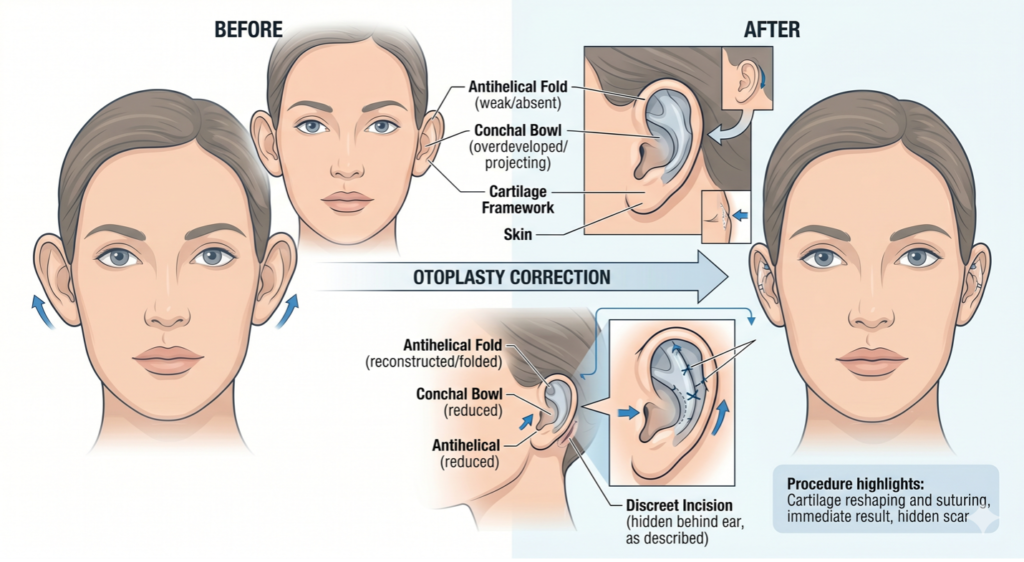
The surgery targets specific structural cartilage elements to reshape the outer ear (auricle).
- Prominent Ears: Caused by an overdevelopment of the deep bowl of the ear cartilage (concha), or a flat outer rim that failed to fold properly during development (antihelical fold).
- Asymmetry: One ear sitting significantly higher, larger, or projecting further outward than the other.
- Macrotia: Ears that are disproportionately large for the individual’s face or head size.
- Lobe Deformities: Elongated, torn, or stretched earlobes caused by trauma or heavy jewelry.
Step-by-Step: How the Procedure is Performed
Step 1: Concealed Incisions
The surgeon places the primary incision completely on the back surface of the ear, tucked deeply inside the natural groove where the ear meets the head. This leaves no visible scarring from the front or sides.
Step 2: High-Definition Liposuction
To fix projection, a small piece of excess cartilage from the deep bowl may be precisely removed. To fix a flat ear rim, the surgeon gently score-sculpts the cartilage to help it fold naturally backward.
Step 3: Internal Matrix Suturing
Permanent, deep internal stitches are placed to secure the newly shaped cartilage firmly into its closer, more balanced position against the head.
Step 4: Skin Closure
The external skin incision behind the ear is closed using fine, dissolvable or removable sutures. A bulky, protective cotton dressing is wrapped around the head to secure the ears in place.
The Recovery Timeline
- The Bandage: You will wake up with a soft, thick head bandage wrapped over your ears. This must be kept completely dry and intact until your first follow-up appointment. It prevents fluid accumulation and keeps the ears perfectly immobilized.
- Sensation: True surgical pain is typically mild to moderate. Patients usually describe a throbbing, aching, or "tight" sensation. Over-the-counter or mild prescribed pain relievers easily manage this.
- Sleeping Position: You must sleep strictly on your back with your head elevated on 2–3 pillows. Do not sleep on your side, as putting pressure on a healing ear can disrupt internal stitches.
- The Unveiling: The heavy clinic wrap is removed by your surgeon between days 3 and 5. You will see an immediate change in the position of your ears, though they will appear temporarily swollen and slightly pink.
- The Supportive Headband: Once the bulky dressing is off, you will switch to wearing a soft, elastic headband (similar to a sports sweatband or tennis headband). This must be worn 24/7 during this week to keep the ears protected.
- Routine Return: Children can typically return to school and adults to desk work by day 5 to 7, provided strenuous activities are avoided.
- Nighttime Protection: After week 2, you can stop wearing the headband during the day. However, you must continue wearing it every night while sleeping for an additional 4 to 6 weeks to prevent the ears from accidentally bending forward against the pillow.
- Activity Restrictions: Avoid contact sports, swimming, heavy playground play, or any activities where the ears could be pulled or bumped for at least 6 weeks
Side Effects vs. Warning Signs
|
Expected Normal Symptoms
|
Warning Signs (Call the Clinic Immediately)
|
|---|---|
|
Temporary swelling, numbness, or bruising
|
Sudden, throbbing, severe pain isolated to just one ear
|
|
Asymmetry during the first 2 weeks due to swelling
|
Fresh blood or foul-smelling fluid oozing from the dressings
|
|
Mild itching behind the ears as incisions heal
|
Extreme swelling or dark purple discoloration after the wrap is off . A fever rising above 101°F (38.3°C)
|