Breast Lift Surgery (Mastopexy)
Breast lift surgery in Muzaffarnagar, also known as mastopexy, is a cosmetic surgical procedure that lifts and reshapes breasts affected by sagging, loss of skin elasticity, pregnancy, breastfeeding, ageing or significant weight changes. During mastopexy, excess skin may be removed and the breast tissue and nipple-areola complex are repositioned to create a more balanced breast contour. The appropriate technique depends on your breast shape, degree of ptosis, skin quality, tissue volume and individual goals.
A breast lift removes excess skin, tightens the surrounding tissue, and repositions the nipple-areola complex to a higher, more youthful position on the chest mound.
Quick Facts
Surgery Time
2 to 3 hours
Anesthesia
General Anesthesia
Stay Required
Outpatient (same-day discharge)
Initial Recovery
5 to 7 days for initial downtime; return to desk jobs within a week
Final Results
Breasts settle into their final, natural shape over 3 to 4 months; surgical lines fade significantly over 12 months
Understanding Breast Drooping (Ptosis)
Breast sagging is medically classified into degrees of ptosis. This classification is based entirely on the position of the nipple relative to the inframammary fold (the natural crease beneath the breast).
- Grade 1 (Mild): The nipple sits right at the level of the under-breast crease.
- Grade 2 (Moderate): The nipple falls below the crease line but remains above the lowest part of the breast tissue.
- Grade 3 (Severe): The nipple sits at the lowest point of the breast mound and points directly toward the floor.
- Pseudoptosis: The breast tissue sags below the crease, but the nipple itself remains positioned above the fold.
Tailoring the Technique: Types of Breast Lifts
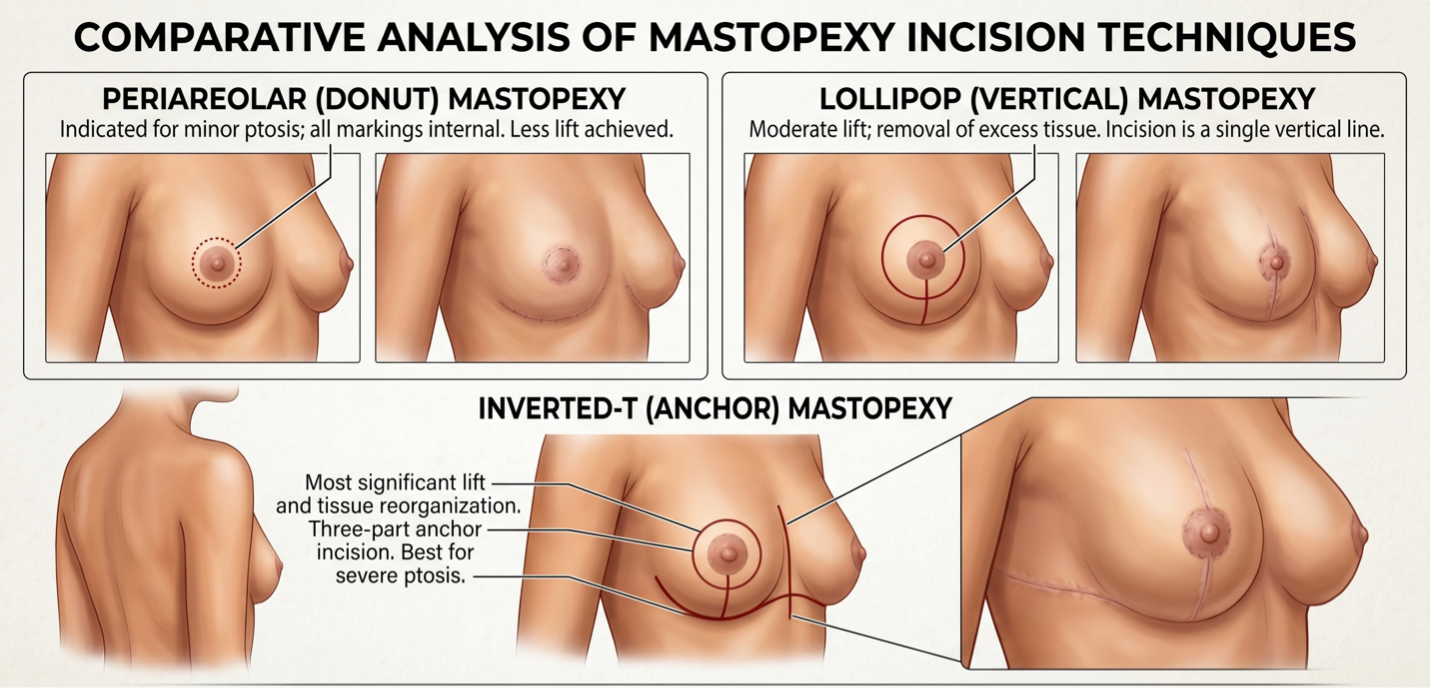
The pattern of incisions depends on the degree of sagging and the amount of excess skin that needs to be removed.
- Periareolar Lift (Donut Lift)
- The Incision: A single circular incision is made strictly around the perimeter of the dark skin of the nipple (areola).
- Best For: Mild sagging (Grade 1) or patients who want to reduce the size of enlarged areolas.
- The Result: Highly discreet, leaving a single hidden scar around the areola.
- Vertical Lift (Lollipop Lift)
- The Incision: One circle around the areola and a vertical line extending straight down to the under-breast crease.
- Best For: Moderate sagging (Grade 2) that requires significant reshaping and tightening of the lower breast tissue.
- The Result: Restores a beautiful, round projection with excellent structural longevity.
- Inverted-T Lift (Anchor Lift)
- The Incision: Follows the “Lollipop” pattern but adds a horizontal incision along the natural fold underneath the breast, resembling an anchor.
- Best For: Severe sagging (Grade 3) or cases involving a massive loss of volume after weight-loss surgery.
- The Result: Offers the maximum amount of tissue tightening and comprehensive reshaping possible.
Step-by-Step: What Happens During Surgery?
Step 1: Anesthesia
You are placed safely under general anesthesia so that you are completely asleep and feel absolutely no discomfort.
Step 2: Marking & Incisions
Following the precise pre-operative blueprint drawn by your surgeon, the tailored incisions are made.
Step 3: Internal Reshaping
The underlying breast tissue is structurally lifted and anchored to the chest wall. The nipple and areola are moved upward to a natural, youthful focal point on the breast. Note: The nipple-areola complex is repositioned using a technique selected according to the patient's anatomy and degree of breast ptosis. Nipple sensation can change temporarily or, in some cases, permanently after surgery. Breastfeeding may also be affected, so patients who plan future breastfeeding should discuss this with their plastic surgeon before surgery.
Step 4: Skin Tightening
xcess, stretched-out skin from the lower portion of the breast is trimmed away. The remaining skin is brought together to hold the newly shaped breast firmly.
Step 5: Seamless Closure
Incisions are closed using meticulous, layered dissolvable sutures. The skin is dressed, and a supportive surgical bra is placed.
The Recovery Timeline
- Sensation: Your chest will feel firm, tight, and sore, resembling a deep muscle ache. This is completely manageable with your prescribed pain medication.
- Garment Support: You must wear your front-closing surgical support bra 24/7. It keeps compression uniform, minimizes swelling, and holds the newly sculpted tissues securely in place.
- Sleeping Position: You must sleep strictly on your back with your upper body elevated on 2–3 pillows to encourage fluid drainage.
- Easing Tightness: The intense early pressure begins to back off. You will find it much easier to move your arms gently.
- Work Return: Most patients feel comfortable returning to desk work, administrative duties, or remote work by day 5 to 7.
- Showering: You can take a gentle shower once permitted by your surgeon, carefully patting any surgical tape completely dry afterward.
- Softening Shapes: The initial high, tight appearance of the breasts will begin to soften, and the tissue will drop into a highly natural, graceful contour.
- Exercise Progress: Light walking is highly encouraged early on. You can gradually resume low-impact workouts around week 3, but you must avoid high-impact jumping, running, or heavy lifting until week 6.
Side Effects vs. Warning Signs
|
Expected Normal Symptoms
|
Warning Signs (Call the Clinic Immediately)
|
|---|---|
|
Feeling of firmness, bruising, and tightness across the chest
|
Sudden, dramatic swelling or severe hardening of just one breast
|
|
Asymmetric healing (one breast settling faster than the other)
|
Intense, burning localized pain or spreading redness over the skin
|
|
Temporary numbness or changes in nipple sensation
|
Fresh, active blood tracking through the bandages. A fever rising above 101°F (38.3°C)
|